
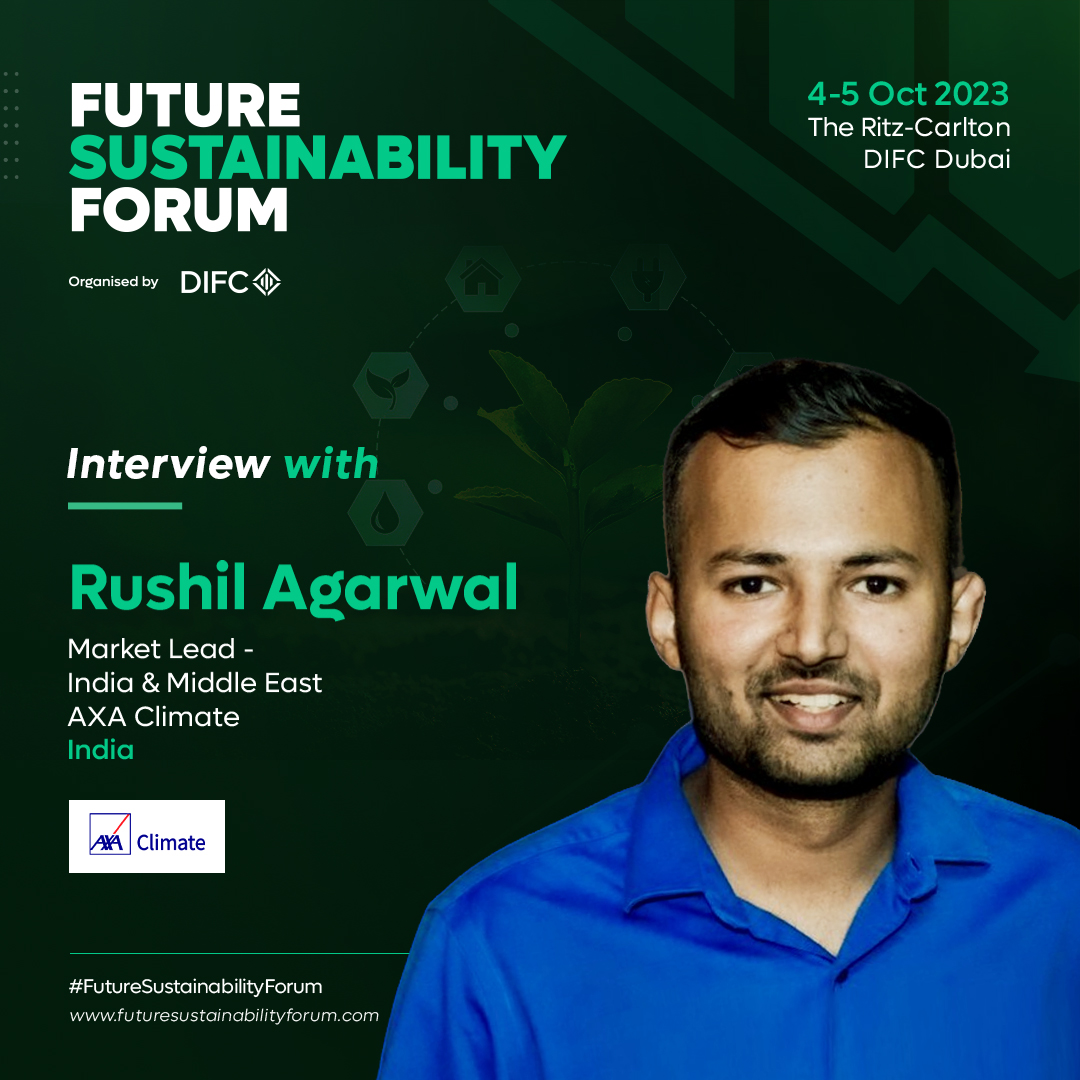
Interview with Rushil Agarwal, Market Lead – India & Middle East at AXA Climate
1. What’s your perspective on the corporate sustainability landscape in the region and the challenges companies face in driving this charter?
With the region hosting two back-to-back COPs, its participation in global sustainability and climate action has gotten a great push, with the government rolling out several initiatives lately. ESG considerations have emerged as a top priority in the policy and strategic frameworks of companies operating in the region. Businesses aspiring to demonstrate commitment to climate change and the UAE’s net-zero emissions target by 2050 are comprehensively evaluating their operations, encompassing possible avenues for growth and potential risks. Public companies face increasing pressure from investors looking to incorporate ESG parameters in their investment decisions. It poses both a challenge and an opportunity for companies to integrate sustainability deep into their business to remain attractive to investors. However, one of the significant challenges we hear from the sustainability leaders of organisations is the need for leadership and board alignment and proactive support for trading short-termism for long-term, responsible growth.
2. How is AXA Climate supporting organisations in their transition? What makes it unique from other companies?
We are a subsidiary of the AXA Group, one of the largest reinsurers in the world. We started AXA Climate in 2019 because of our introspection, i.e. “What commitment should the insurer make to the climate and environmental cause?” We have been answering this question for the past four years by helping large companies and public institutions successfully mitigate and adapt to the climate and the environment. We have four main business lines to achieve this mission – insurance, training, consulting and financing.
Our uniqueness comes from the fact that our legacy is insurance, wherein we underwrite our clients’ climate risks worth billions of Euros to our balance sheet. It requires a backbone of climate science and data, which serves as our DNA as an organisation and informs everything that we do today, be it consulting our clients on assessing the financial impact of physical risk or providing them with training content to demystify the science of sustainability for everyone in the organisation. Additionally, we have our skin in the game through the impact fund we have created in collaboration with Unilever and Tikehau Capital to invest in businesses working on soil health and regenerative agriculture.
3. What is the value proposition for AXA Climate in the region? How would businesses benefit from it in the long run?
In the Middle East region, we support businesses in building capacities across all organisation functions in ESG. The idea is to enable everybody in the organisation, from leadership to frontline, from corporate functions to value-chain partners, to embed sustainability into their day-to-day work and decision-making. Additionally, we work with organisations to screen climate risks for their facilities, assess their financial impact, and create adaptation plans to mitigate those risks.
With companies increasingly taking net-zero pledges, it is clear that the road ahead requires an accelerated push towards integrating the people and planet aspect in business-as-usual practices. However, successful transformations only happened with the organisation building resilience and a culture supporting the change. We partner with firms to give them the necessary tools to catalyse that change.
4. Tell us more about the session you’ll be hosting at the show. What can attendees expect to gain from it?
We work with the CSOs and ESG teams of over 100 global organisations. Through my session, I plan to share our learnings from our work with some of the pioneers and how they went about creating a culture of sustainability in their organisation. There is a striking difference in how sustainability is perceived and pursued in organisations that are leading the transformation as opposed to the ones where it is still considered the role of a few people in a team.
I’m hoping the attendees can take away a practical mental model to apply in their respective business contexts and cultivate allies in their organisation to fast-track the progress on sustainability.
Thank you, Rushil Agarwal. It’s a pleasure to speak with you. We hope you enjoy your experience speaking at the Future Sustainability Forum!